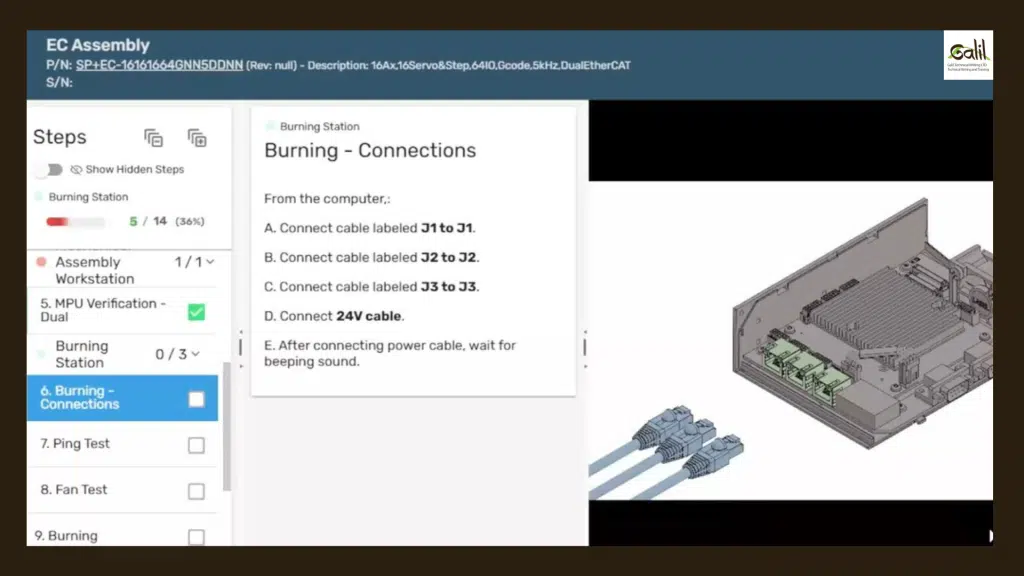
A major shift in European Union (EU) regulations for technical documentation is no longer far off – it is officially here. The rules are published, the start date is set, and the requirements for technical documents are much stricter than before. If you are still using old templates, the difference will be impossible to ignore.
For most Israeli exporters, this regulation is a “hidden” threat. They often don’t hear about it until a European customer flags it during a contract review. By then, it’s usually too late; the time needed to create the right documentation is much longer than the customer is willing to wait.
In this post, we’ll break down exactly what has changed, whether it applies to your products, and how to build a realistic timeline to get compliant before your next big deal is at risk.
What Is EU Machinery Regulation 2023/1230?
EU Machinery Regulation 2023/1230 was published in the Official Journal of the European Union on 29 June 2023. It replaces the Machinery Directive 2006/42/EC, which has governed machinery safety and documentation requirements for the EU market for nearly two decades.
The key dates:
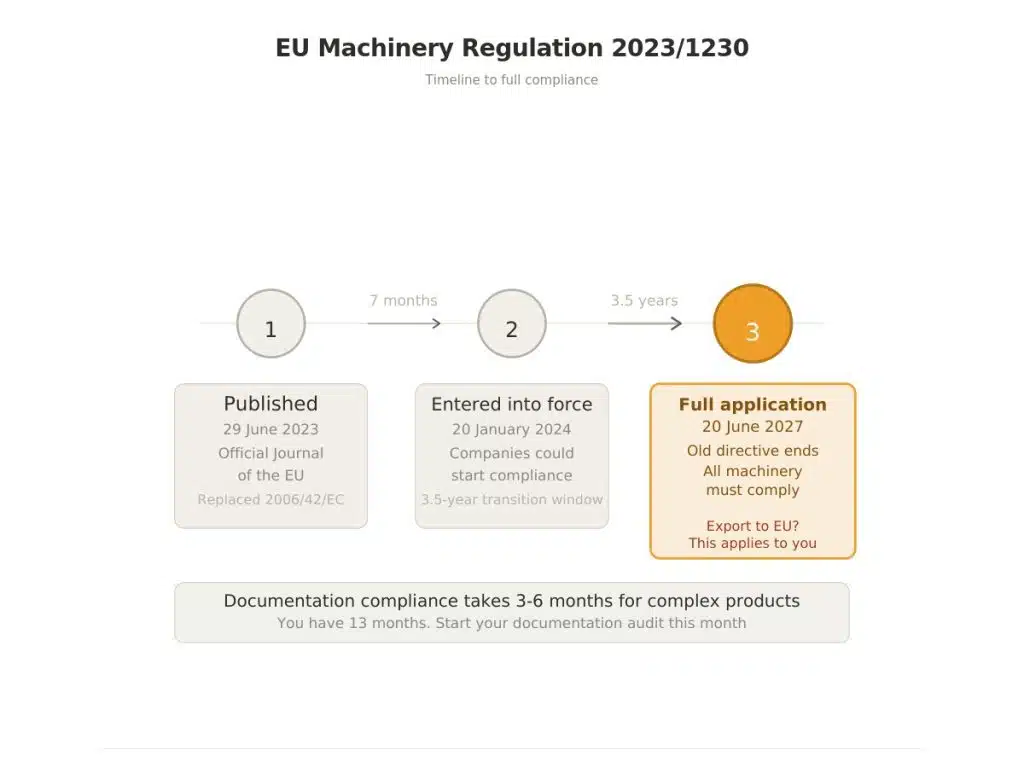
29 June 2023 – Regulation published
20 January 2024 – Regulation entered into force
20 June 2027 – Full application date. From this point, all machinery placed on the EU market must comply with the new regulation. The old Directive will no longer apply.
The regulation applies to all machinery and related products sold into the European Union. Israel is not an EU member, but this is irrelevant – the regulation governs everything that enters the EU market. If your product ships to a German, French, Italian, or Dutch buyer, it applies to you.
The European Commission estimates that the regulation affects approximately 300,000 machinery manufacturers and covers a product market worth over €240 billion annually within the EU. (Source: European Commission Impact Assessment, SWD(2021) 349 final.)
What Changed for Documentation Specifically?
This is the part most manufacturers are underestimating. The 2023 Regulation introduces meaningful changes to documentation requirements that go beyond what the 2006 Directive required.
Digital instructions are now explicitly recognized
Article 10(7) of the Regulation states that manufacturers may provide instructions for use in digital form, provided the end user has the ability to access and read them. Where a user requests a paper copy, the manufacturer must supply one free of charge for 10 years after the machinery is placed on the market.
This is a very significant shift. The 2006 Directive was designed in a world of paper documentation. The 2023 Regulation explicitly acknowledges and accommodates digital-first documentation – and for manufacturers in sectors where digital work instructions and interactive manuals are already standard practice, this creates both an opportunity and an obligation.
Higher bar on clarity, accessibility, and structure
Annex III of the Regulation sets out the essential health and safety requirements for instructions. The language is more specific than the 2006 Directive on several points:
Instructions must be written in a manner that is clear, unambiguous, and easily understood by the intended users
Where the user population includes non-specialist operators, instructions must account for their level of technical knowledge and language capability
Instructions must cover foreseeable misuse scenarios – not just correct use
Safety warnings must be clearly distinguished from other content and must appear at the point of use in the procedure, not only in a general safety chapter at the front
For manufacturers whose current documentation is technically complete but poorly structured – a common situation when engineering teams write their own manuals – this raises the compliance bar.
Software and digital content are now in scope
One of the significant expansions in the 2023 Regulation is the explicit inclusion of machinery that incorporates software as a safety-critical component. If your product’s safety functions depend on software – as is increasingly the case for industrial automation, robotics, and electro-optical systems – the documentation requirements now extend to how that software’s safety behavior is documented for operators and maintenance personnel.
What This Means in Practice for Israeli Exporters
Israel exports a significant volume of industrial and manufacturing equipment to Europe. The sectors most directly affected include industrial automation and robotics, semiconductor and precision manufacturing equipment, electro-optical systems with industrial or safety applications, agricultural technology, and water treatment and infrastructure equipment.
For companies in these sectors, the practical implications are:
Review your current documentation now
The question is not whether you have a manual. The question is whether your manual meets the standard described in Annex III of the new Regulation. Specifically: is it structured by task rather than by product component? Does it address foreseeable misuse? Are safety warnings integrated into procedures rather than isolated in a front section? Is it available in the language of the end user’s country?
Many technically sound manuals will not pass this review. That is not a failure of engineering – it is a reflection of the fact that documentation written by engineers for engineers tends to be organized around how the product works, not around what a user needs to do with it.
Start your documentation project before your next contract
A realistic timeline for producing compliant technical documentation for a complex industrial product is 3-6 months. This assumes that source material – engineering specifications, CAD drawings, test procedures – is reasonably available, and that the manufacturer can provide structured access to the relevant engineering knowledge during a knowledge extraction process.
Companies that wait until a contract is in hand and the delivery date is fixed will find this timeline under serious pressure. The manufacturers that will be ready for June 2027 are the ones starting the process in 2025 and 2026.
A practical point on CE certification more broadly: the documentation package (the technical file) is one of the core requirements for CE marking under the new Regulation. CE marking is the legal requirement for machinery to enter the EU market. Documentation is not separate from compliance – it is part of the compliance evidence.
Consider the digital documentation opportunity
The Regulation’s explicit recognition of digital documentation is worth treating as a strategic opportunity rather than just a compliance item. Manufacturers who deliver structured, interactive documentation – IETMs, digital work instruction platforms, searchable maintenance guides – are not just meeting the minimum standard. They are demonstrating to their European buyers that their product is built for the digital manufacturing environment.
German and Dutch OEM buyers in particular have been specifying digital documentation requirements in procurement contracts ahead of the Regulation’s entry into force. They are not waiting for 2027.
A Documentation Compliance Checklist for Israeli Exporters
Before your next EU export contract review, ask these questions about your current documentation:
- Is the documentation written in the language required by the destination country?
- Is it structured by user task (what the operator or technician needs to do) rather than by product component?
- Are safety warnings integrated into procedures at the point where the hazard occurs?
- Does it address likely misuse scenarios, not only correct operation?
- Is it available in a format the end user can actually access – digitally if they require it, on paper if they request it?
- Does it cover software-dependent safety functions if your product includes them?
- Is it version-controlled and can it be updated efficiently as the product evolves?
If the answer to any of these is ‘I’m not sure’ or ‘not yet’, then that is exactly where to start.
Technical Documentation for EU Machinery Compliance
EU Machinery Regulation compliance is one of the most common documentation requirements we work on with Israeli industrial exporters. We have delivered CE-compliant documentation packages for manufacturers in industrial automation, agricultural technology, water infrastructure, and precision manufacturing – across the full range from print manuals to interactive IETMs.
Galil Technical Writing provides technical writing and training services and holds ISO 9001:2015 certification. We are based in Misgav, Galilee – close to many of Israel’s northern industrial manufacturers – and we have been doing this in efficiently and effectively since 2008. Just ask our clients.
Not sure what documentation your product actually needs? We offer a free 30-minute documentation consulting meeting for Israeli hardware and industrial companies. Book your free consulting meeting: tamir@galiltc.co.il | www.galiltc.co.il
Published by Galil Technical Writing | Misgav, Galilee | galiltc.co.il